
Getting your first period can feel scary, but it’s nothing to worry about! Here’s a quick guide to when your first period might arrive to help you feel more confident and prepared.
Getting your first period is a rite of passage for nearly all women. So the first thing you need to know is — you’re not alone on this journey. If you feel scared, overwhelmed, or anxious, that’s entirely normal. Most of us felt the same way when we got our first period!
Learning about what to expect can be a great way to calm your nerves and feel more prepared before your first period arrives. So we’ve put together a short guide with all the details you need to know about:
- When most girls get their first period
- The signs your first period is on the way
- Symptoms that can come with your period
- What a “normal” period looks like
- How to prepare for your first period
When will I get my first period?
The exact age someone gets their period is different for each of us. This is great news because it means you have zero reason to stress if your period comes later or earlier than your friends. Your body’s on its own unique timetable for healthy development. So there isn’t a better or worse time to get your period — it’s just about the time that’s right for you.
Most girls start their period sometime between 12 and 15 years old (the average age is about 12). Some girls may get their period younger, closer to 8 years old. Others may get their period closer to 16 years old. This is all healthy and normal, which means no reason to fret!
If you still haven’t gotten your period by the time you’re 16, that’s still okay. But you may want to reach out to your doctor to check on timing.
What is a period? Learn more >>
What comes before your first period?
Before your first period, you may begin noticing some physical changes. For example, you may notice your breasts start becoming larger, or hair may start to grow under your armpits and near your vagina (pubic hair).
About 6 months before your period, you may notice a whitish discharge coming from your vagina. It could range in color from clear to white to off-white. And it may appear gooey and thick or slightly sticky and thin.
If you don’t notice these signs, that’s okay too! Your period can come without them and still be healthy.
Signs your period is about to start (PMS)
There are a few symptoms that often come with your period. These symptoms are grouped together under the umbrella term “PMS” or premenstrual syndrome.
They can include:
- Acne
- Bloating
- Headaches
- Sore breasts
- Cramps in legs
- Cramps in belly
- Lower back pain
- Trouble sleeping
- Feeling more emotional
- Feeling more tired than usual
It’s important to note that PMS symptoms are different for everyone! You may experience one, a few, or none of these symptoms. They can also change month to month and even day to day.
In the first few years, it’s common for periods to be more irregular, with PMS symptoms changing each menstrual cycle. After 2 years, most people find their period schedule and symptoms become more regular and predictable.
What’s a “normal” period?
First, it’s important to say that what’s “normal” looks different for each of us. You’ll learn what’s normal for you over the first few years.
That being said, here are some guidelines that might help:
- Menstrual periods typically come once every 4 weeks (28 days), with bleeding that lasts 3 to 8 days.
- For the first 2 years, periods are more likely to be irregular. (That means they may come every 2-3 weeks or skip months entirely.)
- While the bleeding can seem like a lot, most people only lose about 1 to 6 tablespoons of blood and tissue in a given menstrual cycle.
- Period blood comes in many shapes, colors, and sizes. It can be brown, pink, red, liquidy, gooey, or clumpy.
If your period is so heavy that you’re bleeding through a heavy-duty pad or super tampon every hour, you may want to touch base with your doctor to make sure everything’s alright.
How to prepare for your first period
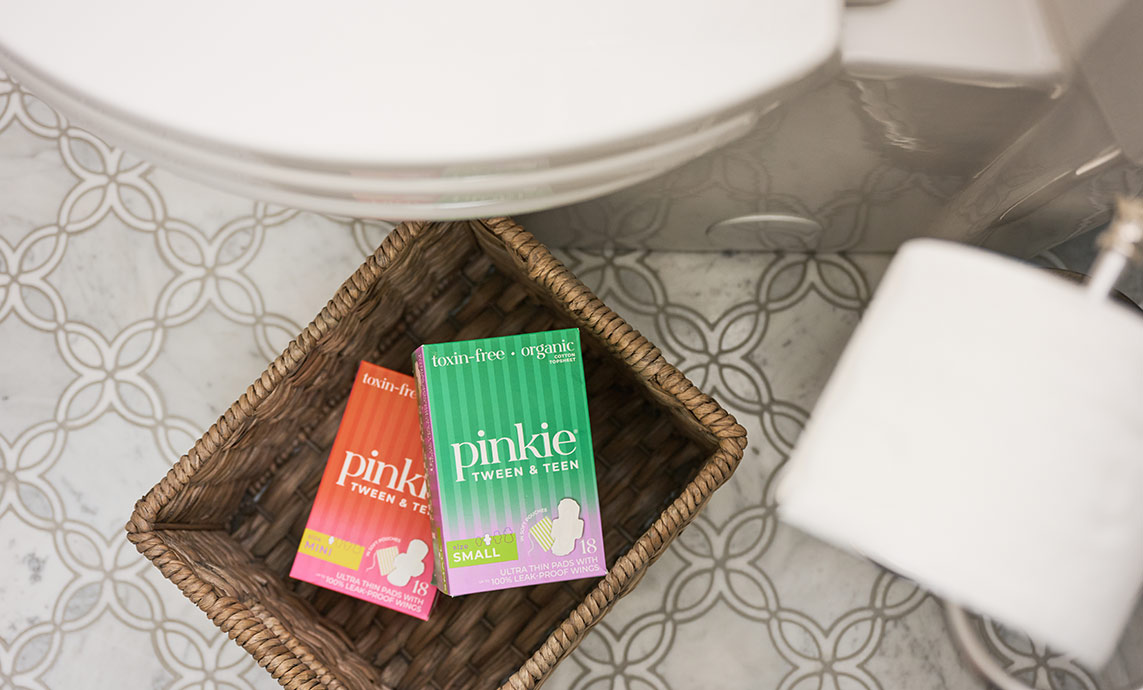
You never really know when your period will show up, so if you’re feeling nervous, one of the best things you can do is prepare. A good idea is to carry extra period products like one of Pinkie’s organic pads, tampons, or an extra pair of underwear in your bag when you go out.
For the ultimate on-the-go solution, check out Pinkie’s Prep Pouch! With 4 highly absorbent, ultra-thin, and leak-proof pads in 3 different sizes, Pinkie’s Prep Pouch is perfect to keep in bags or backpacks, so you’re ready no matter when your period might surprise you.
You could also choose to pack a pair of period underwear or a menstrual cup with you.
If you start your period and don’t have supplies, take a breath before freaking out — you can ask a friend, teacher, parent, or someone you trust. While it can be uncomfortable asking, remember that almost all female adults have gone through their period and will completely understand! Zero judgment or embarrassment included.
If you don’t want to ask for help, that’s okay too. You can fold up toilet paper to help absorb the blood until you can get supplies. If your clothes get stained, try tying your jacket around your waist. Almost everyone with a period knows what it’s like to leak, so if this happens to you, know that you’re not alone!
The most important thing to remember is that you don’t have to do this all on your own. Your parents are there to support you and are great resources that you can lean on to guide you through this process.


